This section outlines the main focus of the FSC and the Coordinator during each assessment phase. Details/examples of the different types of assessments and tools used are explained in 6.4 and 6.5.
Overview of the IASC Recommended Phases of Assessments
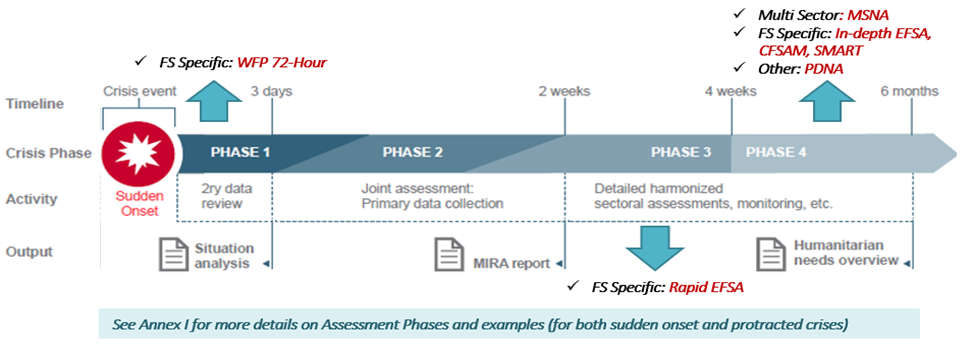
Phase 1 (0-3 days): Initial Assessment and Situation Analysis
In the first 72 hours, the situation analysis provides an initial assessment of the emergency, and an initial understanding of the required response. This is done at inter-sector level. The situation analysis should:
- Estimate scale and severity of the impact of the event.
- Identify affected populations.
- Inform immediate response decisions and appeals (i.e. Flash Appeal).
- Inform the Multi-Sectoral Initial Rapid Assessments (MIRA) in Phase 2.
Phase 1: What is the overall role of the FSC Coordinator? The Coordinator (or CLAs, if there is no Coordinator in-country immediately after a sudden onset crisis) should ensure the participation of the FSC (and cluster partners) in the assessment team for planning, design, implementation (providing sectoral information, collecting data), secondary data review and analysis purposes. This includes contributing to the common analysis and ensuring that results inform the FSC’s initial preliminary and strategic response planning. The FSC analysis should consider the impact on food security and the required assistance. It should also identify any sectoral information gaps (which should be collected during the next phase). See 6.5 for details on the initial assessment and the MIRA (including on the MIRA 5-step process for Phase 1 and 2).
In more practical terms, as relevant, the FSC Coordinator can actively support the process through some/all of the below:
- Contact key informants, working with partners as much as possible, consolidate information available on the areas affected and the severity of the impact. If a contingency plan (inter-agency or FSC specific) exists, it should help support this process.
- Liaise with the RC/HC, relevant national authorities and others to help map the areas reported to be most severely affected and those less affected. This may reflect the depth of flood water, the extent of physical damage or the intensity of fighting etc.
- Examine baseline secondary data available (population groups living in the area(s), agro-ecological and/or livelihood zones in the areas affected; previous shocks/crises in those areas and the lessons learned).
- If possible, make rapid, initial visits to one or two key sites (or alternatively, call Key informants), to compare the current situation with the pre-crisis baseline. This can be done by partners on the ground.
- Prepare a preliminary scenario with key cluster partners, if possible, and agree on priorities and who will do what, where in the next few days (for example if a MIRA, or equivalent rapid assessment, is planned for more detailed analysis).
Examples: See 6.5.1 for examples.
Resources: See roles and responsibilities, and where the Coordinator will contribute during Phase 1 of the MIRA in the IASC Multi-Cluster/Sector Initial Rapid Assessment (MIRA) guidance (2015) and IASC Operational Guidance for Coordinated Assessments in Humanitarian Crisis, p. 15 (the operational guidance will be revised in 2023, check IASC website for updates).
Phase 2 (First Two Weeks): Joint Data Collection and Analysis
Based on the humanitarian needs identified by the initial situation analysis during Phase 1, it is usually recommended that a Multi-Cluster/Sector Initial Rapid Assessment (MIRA) (or the country specific equivalent) is carried out jointly by all relevant clusters during the first two weeks of an emergency response. The Phase 2 assessment should:
- Inform the initial planning of humanitarian response, identify priority actions and adjust appeals (Flash Appeals).
- Define the focus for follow-on in-depth cluster/sectoral needs assessments in Phase 3.
- Establish the baseline for monitoring.
Phase 2: What is the role of the FSC Coordinator? In phase 2, the focus shifts from secondary data reviews to more primary data (focus groups, key informants etc – although not HH level).
From an FSC point of view, the key information outputs should include:
- An initial analysis of the food security situation with numbers, impact (on the population and on food availability, access, including market and price analysis and utilization), causes, forecasts (how the situation is likely to evolve) and risks.
- An updated planning scenario and an initial food security response analysis including options (what kind of interventions and assistance will be required and through which modality), capacities and constraints.
- An indication of any sectoral information gaps, which should be the focus of FSC specific assessments during Phase 3 or 4.
As with phase 1, if the HC and HCT initiates a MIRA (or the equivalent country specific rapid assessment approach), the FSC Coordinator should actively be involved in the process, from initial planning to the final report. This is usually done through the ICCG, which is designated by HCT to implement the MIRA (either the HC or the ICCG may form a dedicated inter-sector Assessment and Analysis Working Group (AAWG) for this purpose).
If arrangements and tools for a MIRA have already been agreed to in advance (see assessment preparedness in 6.3.1), the steps should be clear. If not, the Coordinator, working closely with the cluster partners (and CLA/s), should:
- Actively contribute to the work of the inter-sector Assessment and Analysis Working Group (AAWG)/ICCG (with design and planning) and collect data (ensuring that the core set of food-security-related data is collected at community level)
- Work with FSC partners to coordinate the collection of any additional information (e.g. on market systems for food, agricultural inputs and other livelihood support systems, and any existing in-country safety-net mechanisms) needed to prepare a situation analysis and an adequate food security response analysis.
- Undertake the food security sectoral analysis – in close collaboration with partners (and government counterparts where possible).
- Support the inter-sector AAWG with the inter-sectoral analysis (which is endorsed through the HCT)
- Provide inputs for the key humanitarian indicators used by OCHA to present up to date overviews which consolidate needs assessment and response information and provides a structured format for shared analysis of a humanitarian situation.
- Help to ensure that the Phase 2 assessment results are used to inform operational planning within the FSC and that they are reflected in a flash appeal revision.
It is recommended to initiate discussions with FSC partners on arrangements and a schedule for a follow-on emergency food-security assessment appropriate to the context before the rapid assessment is completed (see phase 3 below).
Resources: See the IASC Multi-Cluster/Sector Initial Rapid Assessment (MIRA) guidance (2015), p. 7. See also IASC Operational Guidance for Coordinated Assessments in Humanitarian Crisis, p. 16 (check IASC website for expected updates in 2023). See more details on the MIRA, country examples and resources in 6.5.2.
Phase 3 (weeks 3-4) and Phase 4 (week 5 onwards): Sectoral Assessments
From Phase 3 onwards, and especially from Phase 4, the assessment focus is to ensure that adequate sector specific data is available to adjust the response and to support a shift from lifesaving assistance to recovery. The purpose is to ensure the following for each phase:
Phase 3:
- The situation and trends are analysed.
- The ongoing response is adjusted.
- Detailed planning for humanitarian relief/early recovery is informed.
- A baseline for operational and strategic performance monitoring is established.
Phase 4:
- The situation and trends are analysed.
- The phasing out of life-sustaining activities is supported.
- The detailed planning for humanitarian relief and (early) recovery is supported.
- The assessments feed into performance monitoring.
Phase 3: What is the overall role of the FSC Coordinator?
The need for detailed sectoral data becomes more pressing in phase 3 and clusters should coordinate single-cluster/sector in-depth needs assessments. These should at minimum be harmonized or, when possible, undertaken jointly by cluster partners.
If preparedness activities have been undertaken prior to the emergency (see 6.3.1 and 5.8), the FSC may already have phase 3 assessment tools prepared. If not, as mentioned, planning discussions on phase 3 (and phase 4) food-security assessments (appropriate to the context) should be initiated by the Coordinator as soon as possible. This includes agreeing on:
- The schedule and the method/s (assessment tool) to be used and whether a “joint” assessment is possible or only “harmonized” assessments by partners.
- The core food security data to be collected by all partners (jointly or in the context of their own assessments) to calculate key sector indicators and, to the extent possible, the data collection and sampling methods to be used.
- Practical arrangements and responsibilities including geographic sharing of responsibilities to ensure reasonable coverage of all main areas and arrangements to share data and undertake a joint situation analysis.
- Arrangements to be made to ensure broad local participation in the assessment process (ensure translations of data collection instrument, training if needed and possible).
- Close collaboration with the technical ministries – for example, to encourage them to lead the needs assessments (pending capacity) but also to ensure their data is collected.
See 6.4 for details (including examples and resources) on food security specific assessments.
Building on the above, during Phase 3 assessments the Coordinator should work closely with FSC partners to ensure the coordination of assessments and joint sectoral analysis by:
- Coordinating the design and implementation of primary data collection through joint or at a minimum, harmonized assessments.
- Ensuring data (from a joint assessment or different organizations’ assessments) is compiled, processed and analysed. A standard database should be developed and regularly updated based on agreed key indicators – this is usually done by the IMO.
- Leading the cluster specific analysis of the humanitarian situation including a detailed situation and trend analysis of both the needs and the response, and informing the ongoing response and early recovery planning as well as the revision of emergency response proposals (Flash Appeal).
- Coordinate and consolidate ongoing information from monitoring systems – the FSC situation analyses, which builds on the different phases of assessments should be regularly up-dated on the basis of information from ongoing situation monitoring.
Working with the ICCG and OCHA, the Coordinator should:
- Ensure the results of the FSC specific analysis are used in the inter cluster/sector analysis, which identifies linkages and issues that cut across clusters/sectors and help achieve a common understanding of priority interventions, areas and vulnerable groups, as well as establish a common basis for forecasting possible trends and scenarios. See 6.7.1 on IPC and 6.8 on the HNO.
- Ensure FSC assessment data are used to populate a set of key humanitarian indicators and reflected in relevant OCHA products.
Phase 4: What is the overall role of the FSC Coordinator?
Phase 4 is essentially a continuation of phase 3 but often with recovery considerations becoming more explicitly integrated in the FSC assessments and analysis. From the second month, the need for such data usually increases, in particular on the part of the government (early recovery considerations are already part of assessments under Phase 3). Food security sector assessments should be forward-looking while maintaining focus on the ongoing emergency response. Detailed assessments may be needed in relation to agriculture sector recovery, livelihoods, food security and/or specific sub-sector assessments in relation to crops, livestock, fisheries, forestry and natural resources, etc.
In some cases, formal post-disaster or post-conflict needs assessments (PDNA/ PCNA) may be carried out, upon the request of the government (with CLA participation rather than the FSC).
The Coordinator should work closely with FSC partners to:
- Review the previously agreed assessment plan (calendar/framework), schedule and practical arrangements and agree on which food-security-related assessments or surveys might be needed (information gaps identified during Phase 3 help define the primary data collection requirements) – including the expected outputs – how and by whom they should be undertaken (the processes, roles and responsibilities).
- Agree on the approaches and methods to be used (based on relevant available methodologies and guidance).
Support: The Coordinator can lean on in-country resources including the FSC NAWG (or similar TWG), technical staff and support units available (for example on technical matters, sampling etc. In case in country resources are limited, the gFSC can support (gFSC Help Desk).
Resources: IASC Operational Guidance for Coordinated Assessments in Humanitarian Crisis, pp. 17-18 (check IASC website for expected updates in 2023). See 6.4 for food security specific assessment guidance.