The Multi-Cluster/Sector Initial Rapid Assessment (MIRA) is an IASC developed joint needs assessment tool for sudden onset emergencies. Although often modified and adapted at country level, it is one of the first steps towards setting overall objectives for the response plan that takes shape during the first 30 days of a large sudden-onset emergency. The HC and HCT, in consultation with government authorities and in close coordination with the clusters, jointly determine the scope, establish a timeline and a coordination structure: the clusters will work through the ICCG – or a dedicated AAWG (set up by the HC or the ICCG).
The MIRA process spans Assessment Phase 1 and 2 and focuses on producing a situation analysis during the first three days after the onset of an emergency, followed by a MIRA report to be released within 2 weeks. The MIRA methodology follows a 5-step process (see diagram).
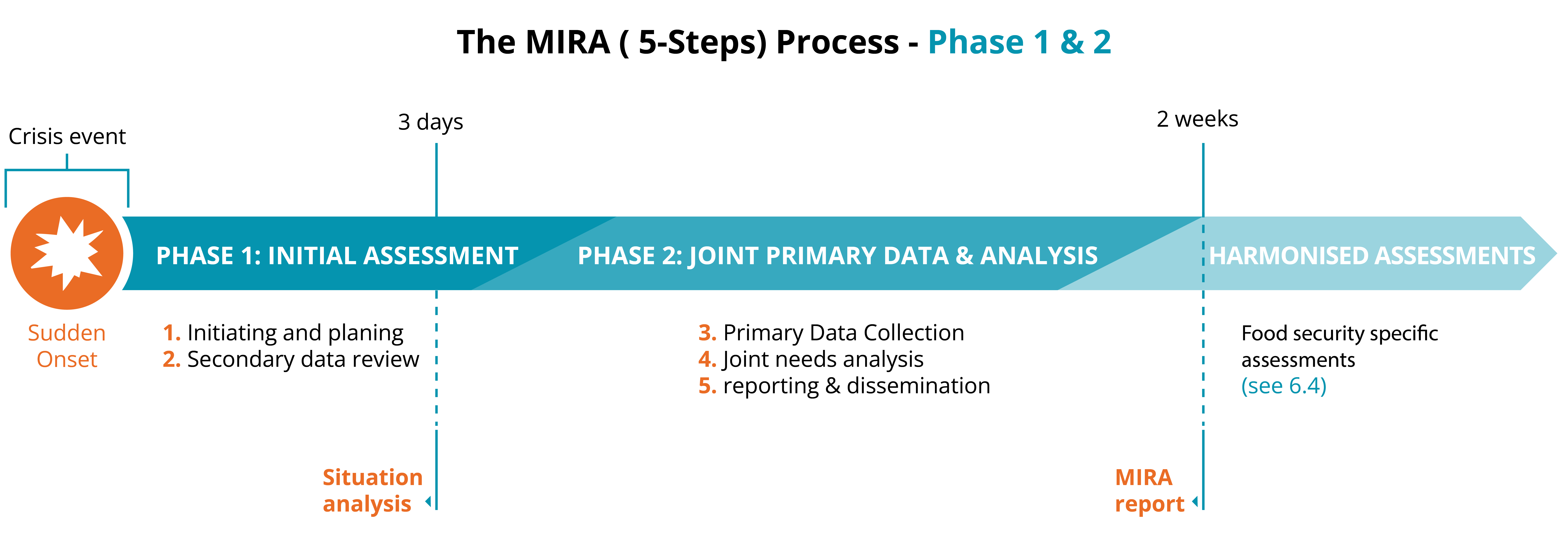
The MIRA aims to shed light on the crisis impact (scope and scale i.e. the humanitarian profile and the severity i.e. the conditions of the affected population) and the operational environment (gaps in the response and operational constraints). Based on its findings, humanitarian actors can develop a joint plan (Flash Appeal), mobilize resources and monitor the situation. The results of the rapid assessment also inform and support the design of subsequent sectoral needs assessments and analysis, which are often more detailed and operational in focus.
What is the role of the FSC Coordinator? The Coordinator plays an important role in both phase 1 and 2 of the MIRA process - see 6.3.2 for details. For an overview of the five steps of the MIRA process as well as associated roles and responsibilities, see the IASC Multi-Cluster/Sector Initial Rapid Assessment (MIRA) guidance (2015).
Traditional MIRA Example: See the MIRA Central Africa Republic (OCHA/WFP, 2014).
MIRA as an Adaptable Assessment Tool: The MIRA is the IASC recommended approach for joint rapid assessments during Phase 2 and having a MIRA preparedness package in place before a crisis strikes, is recommended for HCTs, where possible. However, in reality, the tools used in the different phases and the related actions are often contextualised and adapted to fit the specific country context requirements and resources – also the MIRA timeframe is conceptual in nature. The MIRA therefore can take different shapes at country level and goes by different names although the multi-sectoral principles remain.
Examples of Different Country Specific Phase 1 and 2 Assessments – Reports and Tools:
Country Specific Multi-Sector Reports:
- Bangladesh: See the Joint Needs Assessment (JNA) report for Cyclone Amphan (2020).
- Nigeria: See the Multi-sector Initial Rapid Needs Assessment (IRNA) - Teachers' Village Camp, Maiduguri (Nigeria, 2019).
- South Sudan: See the Initial Rapid Needs Assessment (IRNA) Report (South Sudan 2017).
Country Specific Multi-Sector Tools:
- Bangladesh: In Bangladesh, tools for Joint Needs Assessments (JNAs) have been jointly developed at HCTT level for both phase 1 and 2 (based on the MIRA) to allow for swift assessment response to cyclones, floods etc. See the Joint Needs Assessment Decision Tree to show the decision making process that leads to a Phase 2 JNA (MIRA). Phase 1 and 2 tools are available here).
- Nigeria: See the Nigeria Initial Rapid Needs Assessment (IRNA) Questionnaire Version 3.0 (2018).
- South Sudan: South Sudan A Brief Guide to the Inter-Agency Rapid Needs Assessment (IRNA) Policy and Process (OCHA, 2014). The South Sudan FSLC has a detailed repository of tools to support the food security sector component of the IRNA – contact the GST for the link.
TIPS:
- Joint multi-sectorial assessments are usually prioritized, especially when resources and capacities are limited (often at the beginning of a crisis). However, the FSC should advocate for resources and capacity for food security partners to conduct an assessment as soon as possible after the sudden crisis (usually from phase 3 onwards, or earlier if the Cluster has the capacity – this is country specific).
- Note that, if the intersectoral assessment process (and the inter-sector AAWG) is slow, FSC partners (e.g. WFP RAM) may proceed with collection of data/information – in such cases the Coordinator should ensure the ICCG or inter-sector AAWG is informed.
- Note that joint multi-sectoral assessments (MIRAs and MSNAs) may identify areas where more in-depth food security assessment is needed.
Support: The Coordinator can lean on in-country resources including the FSC NAWG (or similar TWG) and technical CLA support units (for example on technical matters, sampling etc.). In case in country resources are limited, contact the gFSC (gFSC Help Desk).
Guidance: See the IASC Multi-Cluster/Sector Initial Rapid Assessment (MIRA) guidance (2015). The MIRA is an integral part of a larger frame of humanitarian assessments outlined in the IASC Operational Guidance for Coordinated Assessments in Humanitarian Crisis (see pp. 15-17 – note that this guidance will be revised in 2023, check IASC website for updates).
Refugee Contexts: For rapidly assessing humanitarian crises in refugee contexts, the UNHCR applies the Needs Assessment for Refugee Emergencies (NARE) framework (UNHCR 2015). The NARE provides guidance for pre- and post-crisis secondary data analyses (see NARE checklist) and for primary data collection.